The Fender Champ
A small amp with a long shadow

The Fender Champ was never designed to be legendary. It was designed to be affordable, compact, and simple. And yet, across more than seven decades of production, it has quietly become one of the most recorded guitar amplifiers in history.
The Champ’s story is not about volume or power. It is about restraint. Each time Fender revised it, the changes reflected broader shifts in manufacturing, music, and recording culture. What never changed was the core idea that a guitar amplifier could be expressive without being loud.
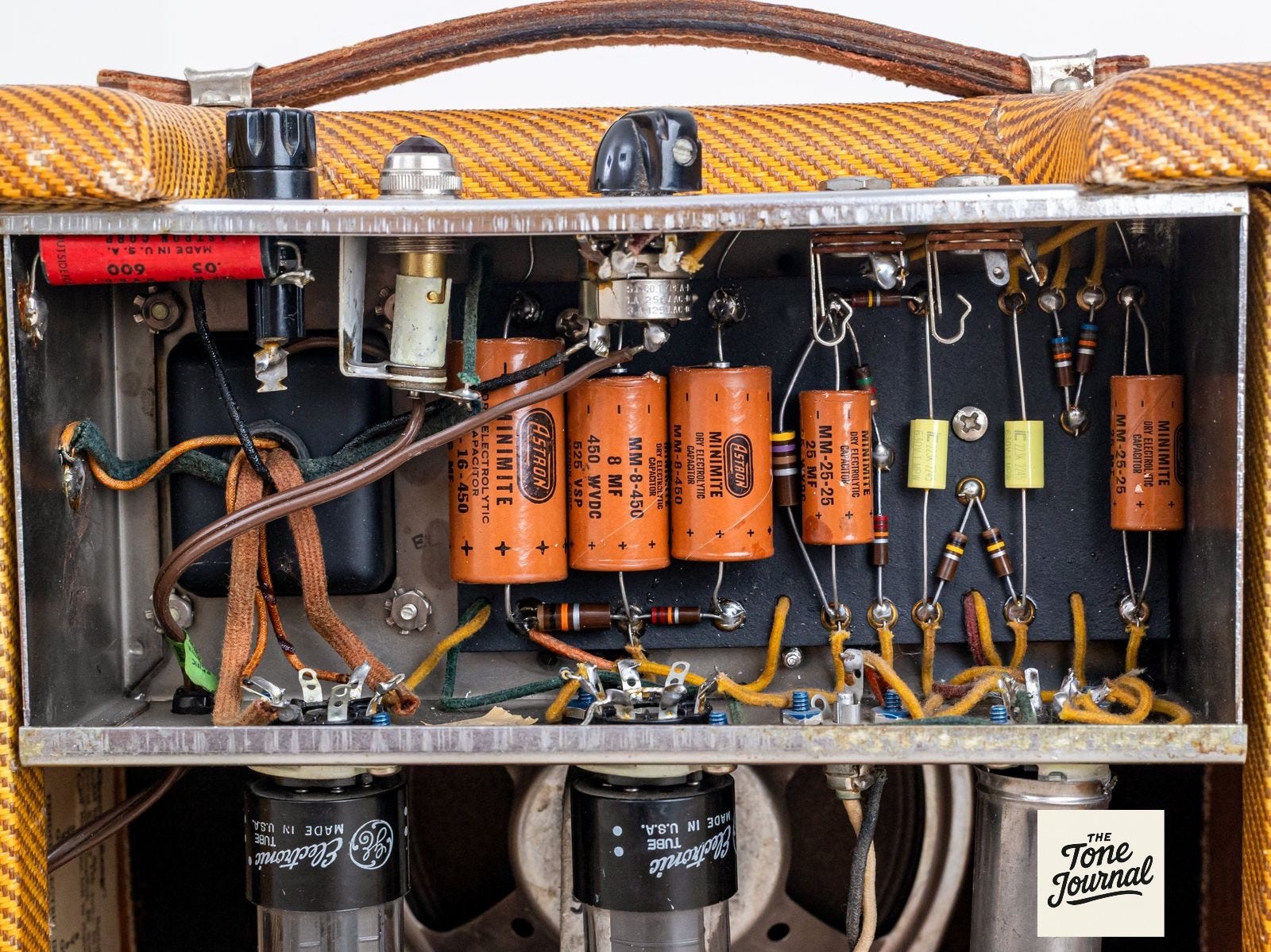
At its foundation, the Champ’s circuit language came from a familiar source. Like many early American amplifiers, its basic topology was informed by example designs published in the RCA Receiving Tube Manual. These reference schematics outlined simple single-ended 6V6 amplifier stages intended to demonstrate proper tube operation rather than musical character.
Leo Fender took those utilitarian building blocks and made them his own. Component values were adjusted. Signal paths were simplified. The circuit was voiced not for laboratory measurements, but for guitar players. What emerged was not a technical exercise, but an instrument. One that translated touch, dynamics, and intent into sound with very little standing in the way.
This is the history of the Fender Champ, generation by generation, and why players like Eric Clapton, Keith Richards, and Billy Gibbons found a place for it in the studio.
The earliest Champions
Late 1940s to early 1950s
The Champ lineage begins in 1948 with Fender’s Champion series. Early models like the Champion 600 and Champion 800 were among Leo Fender’s first commercial amplifiers. These amps were extremely simple. A single power tube, a small speaker, and minimal controls were all that stood between the guitar and the listener.
These amps were meant to amplify cleanly and reliably for students and working musicians. Still, the architecture of these early circuits laid the foundation for what the Champ would eventually become. A single ended output stage. No phase inverter. No excess circuitry. The guitar was always directly connected to the power section.
This simplicity would later become the Champ’s greatest strength.
The tweed Champ and the 5F1 circuit
Mid 1950s to early 1960s
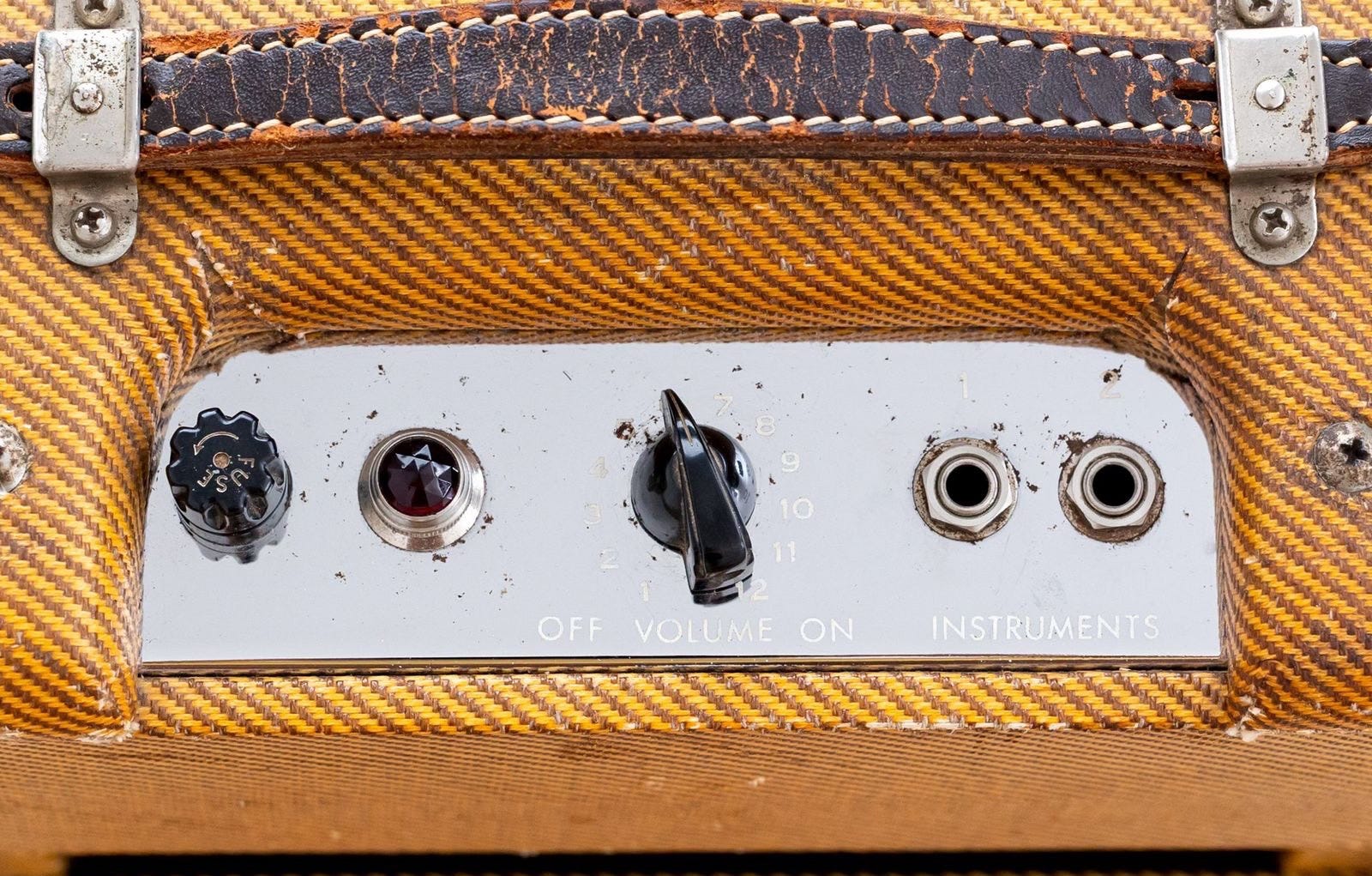
By the mid 1950s, Fender had refined the Champ into what many consider its definitive form. The tweed era Champ, most famously represented by the 5F1 circuit, distilled the amplifier down to its essentials.
One preamp tube
One 6V6 power tube
One small output transformer
One volume control
There was no tone stack to absorb signal and no phase inverter to split it. The result was an amplifier that responded immediately to pick attack, guitar volume, and touch. As the volume control was turned up, the amp did not abruptly distort. It bloomed. Harmonics stacked naturally, compression increased gradually, and the speaker became an active part of the sound.
This was not an amp that masked technique. It exposed it.
In hindsight, the tweed Champ arrived at the perfect moment. Recording studios were becoming more sophisticated, and engineers were beginning to value controlled guitar tones that sat naturally in a mix. A small amp driven hard could be placed close to a microphone without overwhelming the room.
The Blackface Champ and Vibro Champ
1964 to 1967
When Fender entered the Blackface era in the mid 1960s, the Champ received both cosmetic and functional updates. The control panel changed to black with white lettering, and the circuit evolved into the AA764 design.
Unlike the tweed Champ, the Blackface Champ introduced a tone stack with bass and treble controls. This gave players more flexibility and a slightly cleaner overall character, especially at lower volumes. The amp retained its single ended topology and modest power output, but the voicing became more balanced and refined.
The Vibro Champ, introduced around the same time, added tremolo without fundamentally altering the core signal path. It became a favorite for recording engineers looking for movement and texture at reasonable levels.
This era represents a subtle shift in philosophy. Fender was responding to player demand for more control and polish, while still preserving the Champ’s immediacy and feel.
The Silverface years
Late 1960s through early 1980s
The Silverface era brought visual changes and incremental circuit revisions across Fender’s lineup. Champs from this period often featured slightly higher voltages and different component values, but the overall architecture remained intact.
While Silverface Champs are sometimes overlooked in favor of earlier versions, they continued to deliver the same essential qualities. Touch sensitivity. Natural compression. Manageable volume.
For studios and players who understood what the Champ was good at, these amps remained valuable tools rather than relics.
Why the Champ worked in the studio
The Champ’s studio success came down to a few fundamental qualities.
It could be driven into musical saturation without excessive volume
It responded directly to the player’s hands
It occupied a focused midrange that recorded well
It left space for other instruments
These characteristics made it ideal for layering parts and capturing expressive performances without fighting the room.
This is where its association with legendary players becomes meaningful.
Eric Clapton
Eric Clapton’s recorded tones, particularly in the early 1970s, were shaped by small amps pushed into natural breakup. While Clapton is associated with many amplifiers, the Champ fits squarely into the philosophy behind those sounds.
A small amp allowed him to achieve sustain and harmonic richness without overpowering a band or studio environment. The Champ’s ability to translate touch into tone made it a logical choice for expressive, vocal guitar lines.
Keith Richards
Keith Richards has long favored low wattage amplifiers in the studio, often pairing them with larger amps to create layered textures. The Champ’s compressed breakup and focused response made it ideal for rhythm parts that needed to sit in a mix without dominating it.
Rather than chasing volume, Richards used small amps to create feel and attitude. The Champ excelled at exactly that.
Billy Gibbons
Billy Gibbons built his sound around the idea that great tone comes from simple circuits driven properly. Early in his career, small Fender amps played a significant role in shaping his recorded guitar sounds.
The Champ’s rawness and responsiveness aligned perfectly with Gibbons’ approach. It delivered big notes without big volume, allowing nuance and articulation to come through clearly on tape.
Why the Champ still matters
Across its many iterations, the Fender Champ never tried to compete with larger amplifiers. It did something else entirely. It translated human touch into sound with minimal interference.
That quality is why it continues to show up in studios, collections, and modern recreations. It reminds players that tone does not come from complexity. It comes from connection.
The Champ remains one of the clearest examples of how less can truly be more.
Ben’s Final Thoughts
The Champ isn’t difficult because it’s flawed. It’s difficult because it’s honest. When you turn a Champ up into its natural overdrive, there is very little between the guitar and the speaker to smooth things over. That can be exhilarating or frustrating, depending on how well the rest of the system is working together. The guitar matters. Some pickups push the low end in a way that overwhelms a small output transformer and an eight inch speaker. The cabinet matters too. Running a Champ into a larger external cabinet often reveals just how balanced and articulate the circuit really is. And in some cases, the circuit itself benefits from subtle refinement. Allowing too much low frequency energy to pass through a design like this can create compression and distortion that a small speaker simply cannot materialize cleanly. When that low end is managed correctly, the Champ stops sounding congested and starts sounding intentional. At its best, a Champ is not a blunt instrument. It is a precision tool. But like any precision tool, it rewards thoughtful pairing, not brute force.
Thank you for putting this into words. I have a champ. One day I added a speaker out jack and sent it into a 2x12 bandmaster cab with its original Jensens. Bliss.
Thank you for this. I have a ‘55 Champ.